


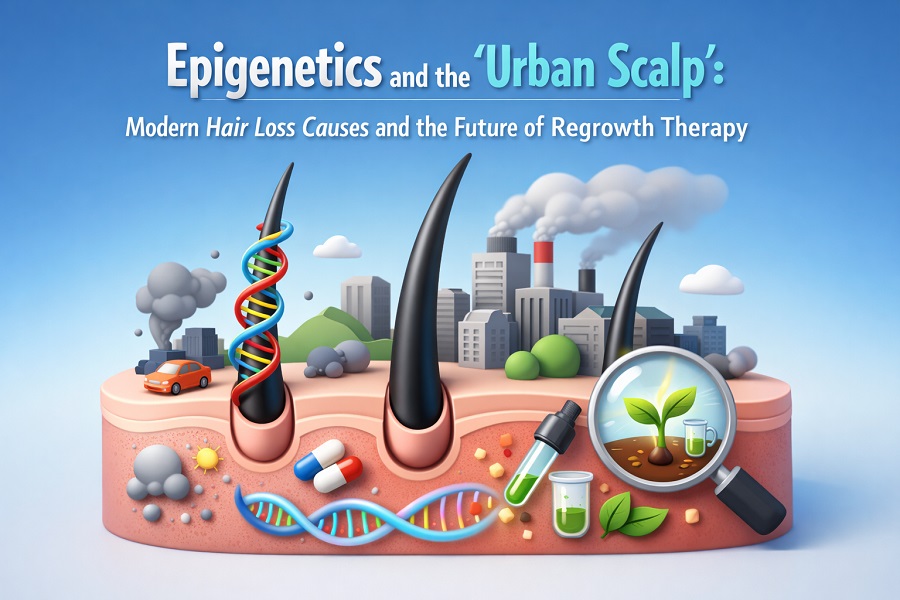
In the clinical landscape of 2026, the understanding of hair restoration has evolved far beyond basic genetics. While “hereditary thinning” remains a primary diagnosis, researchers are increasingly focusing on the role of epigenetics—the study of how your environment and lifestyle behaviors can cause changes that affect the way your genes work.
The emergence of the “Urban Scalp” phenomenon highlights how external stressors, ranging from microscopic pollutants to chronic cortisol elevation, act as significant hair loss causes. To combat these modern triggers, a regrowth hair strategy must be both biologically targeted and environmentally defensive.
The Epigenetic Shift: Beyond the DNA Sequence
For decades, many believed that if hair loss was in your family tree, your follicular fate was sealed. However, epigenetic research has revealed that while you cannot change your DNA sequence, your environment can “turn on” or “turn off” specific genes related to hair growth.
For instance, the sensitivity of hair follicles to androgens can be heightened by external factors. This means that even someone with a low genetic predisposition to thinning may experience hair loss if their “Urban Scalp” environment triggers the expression of dormant thinning genes. This shift in perspective has transformed how we view hair loss reasons, moving from a static genetic view to a dynamic environmental one.
Defining the “Urban Scalp”: Modern Hair Loss Causes
The modern city-dweller faces a unique set of physiological challenges. In 2026, three primary “Urban Scalp” factors have been identified as major drivers of premature follicular aging.
1. Particulate Matter (PM 2.5) and Oxidative Stress
Urban air is saturated with particulate matter (PM 2.5), microscopic soot, and heavy metals. These particles are small enough to settle into the pores of the scalp and penetrate the hair follicle. Once inside, they trigger the production of Reactive Oxygen Species (ROS)—free radicals that damage the proteins and lipids essential for hair structure. This oxidative stress leads to “inflammaging,” a chronic low-grade inflammation that prematurely pushes follicles into the shedding phase.
2. The Cortisol-Hair Connection
Chronic urban stress leads to sustained levels of cortisol. High cortisol levels have been clinically shown to degrade scalp proteoglycans and hyaluronic acid—the “scaffolding” that supports the hair follicle. When this scaffolding breaks down, the follicle loses its structural integrity, making it difficult to sustain a long growth cycle or produce a thick hair shaft.
3. Circadian Disruption and Blue Light
The hair follicle has its own “internal clock.” Research suggests that follicles are highly sensitive to circadian rhythms. Exposure to artificial blue light late into the night and irregular sleep patterns common in urban lifestyles can disrupt the “clock genes” in the hair bulb. This disruption interferes with the follicular transition from the resting phase to the growth phase, stalling regrowth hair efforts.
The Future of Therapy: Engineering the “Regrowth Hair” Environment
To address these modern hair loss causes, a treatment plan must do more than just provide raw nutrients. It must actively manage the scalp’s micro-environment.
The Role of Vasodilation in Pollution Defense
One of the most effective ways to counteract the “Urban Scalp” is by increasing micro-circulation. A clinical treatment that promotes vasodilation, such as topical Minoxidil, does more than just grow hair; it helps “flush” the follicular niche. By increasing blood flow, the scalp is better equipped to deliver antioxidants to the hair bulb and remove the metabolic waste products generated by oxidative stress.
Re-establishing Potassium Channel Conductivity
Pollution and inflammation can interfere with the electrical signaling of the hair follicle. Modern regrowth hair solutions work by re-opening potassium channels. This hyperpolarization of the cell membranes serves as a “reboot” for the follicle, overriding the negative epigenetic signals sent by the environment and forcing the hair back into a robust Anagen (growth) phase.
Synergistic Strategies for the Modern User
If you live in an urban environment, your approach to regrowth hair should be multi-layered. Combining a clinical anchor with environmental protection is the key to long-term success.
|
Factor |
Impact on Scalp |
Recommended Intervention |
|
Pollution |
Oxidative stress and “inflammaging.” |
Antioxidant-rich cleansers and daily clinical stimulation. |
|
Hard Water |
Mineral buildup that blocks absorption. |
Monthly clarifying treatments to ensure treatment penetration. |
|
Stress |
Cortisol-induced follicle degradation. |
Consistency with a topical vasodilator to maintain the growth cycle. |
|
UV Exposure |
DNA damage to follicular progenitor cells. |
Scalp-specific sun protection and evening regrowth applications. |
The “Follicular Banking” Philosophy
Because modern hair loss causes are often cumulative, the 2026 philosophy of “Follicular Banking” has become essential. This approach treats hair density like a savings account. By starting a regrowth hair routine at the first sign of urban-induced thinning, you are “depositing” density back into your follicles.
Waiting until thinning is visible to the naked eye often means that 50% of the density has already been lost to the miniaturization process. Proactive treatment ensures that the “Urban Scalp” stressors never reach the threshold required to cause permanent follicular dormancy.
Conclusion: Adapting to the Modern Environment
The “Urban Scalp” is a reality of 2026, but it does not have to be a sentence for permanent hair loss. While our environments have changed, the fundamental biology of the hair follicle remains resilient—provided it receives the correct signals.
By understanding how epigenetics and modern stressors act as hair loss causes, we can shift our focus toward more sophisticated, clinical solutions. Success in regrowth hair today requires a commitment to daily clinical intervention, environmental defense, and the patience to let the biological “reset” take place. In the battle against the modern city, a science-first approach is your strongest defense.

